
Academic Editing for Business Researchers
When you've been living with a paper for two years, it's hard to see its blind spots.
I bring the perspective of a reader coming to it fresh, but with 20+ years of editing business research behind me.
I help academics prepare papers for submission, work through R&Rs, and figure out what to do with manuscripts that simply aren't working.
Sometimes your paper needs a careful edit. Sometimes it needs much more than that.
And sometimes, it's the writer who needs support: someone to talk through the problems with, help you make decisions, and get you moving again.
What kind of editing does my paper need?
You may well know exactly what you need. Perhaps the paper is nearly ready to submit and you just want a human eye to check the language carefully. Or you've been told by a reviewer that the writing needs work.
But sometimes it's difficult to know. A paper can feel too long, repetitive or hard to follow without it being obvious where the problem lies. You may have rewritten the introduction ten times and still not be happy with it. It could be that the sentences are perfectly good, but somehow the paper as a whole isn't coming together.
Send me your manuscript. I'll read it and tell you what I believe it needs.
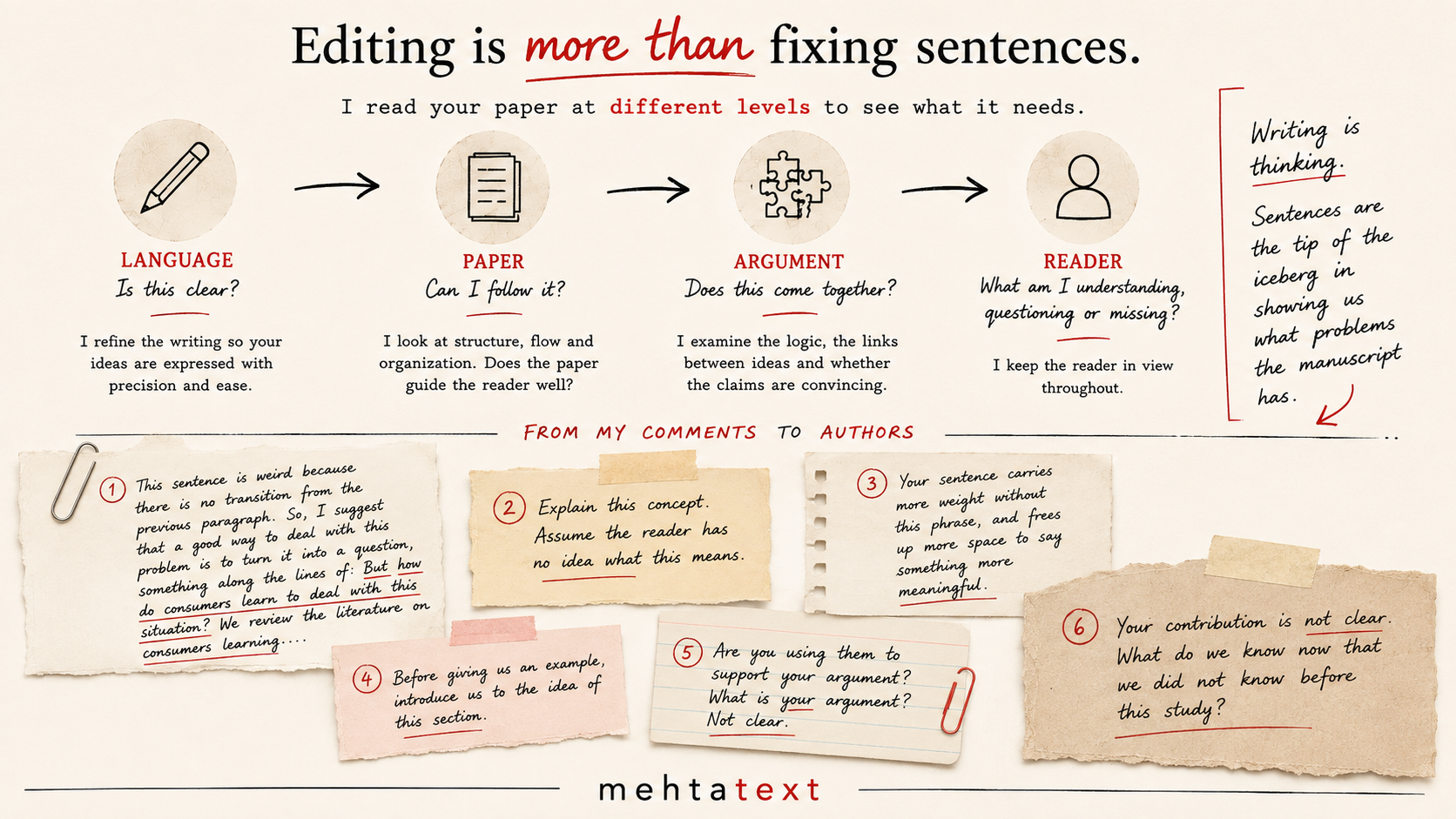
What does academic editing actually involve?
Every paper is different, so I don't work through a standard editing checklist. I read the manuscript and pay attention to what gets in the way of the paper doing its job.
Sometimes that's the writing itself: sentences that are awkward, unnecessarily complicated or simply too long. I look for repetition, vague language and places where the reader has to work harder than they should.
But I'm also reading the paper as a whole. If I lose the thread of the argument, don't understand why something matters, or reach the end of a section wondering what I was supposed to take away from it, I'll tell you.
And yes, I fix the commas too.
What I might look at in your paper
The writing
Is it clear? Are sentences doing too much? I look for repetition, vague language, awkward phrasing and places where the writing gets in the reader's way.
The argument
Can I see what you're arguing and how you're getting there? I'll flag gaps in the reasoning, unsupported claims and places where connections between ideas are unclear.
The introduction
Does it give me a reason to care about the research? Does it set up the paper I'm actually about to read? Does it contain all the elements that an introduction should?
The literature review
How well are you engaging with the existing literature? I look at how you've positioned your study in relation to prior work and whether you've made its limitations clear. Ultimately, I ask whether the literature review builds a convincing case for your research.
The contribution
What do we know now that we didn't know before your study? Are your contributions actually “findings” clothed as a contribution? How can other academics use your frameworks to think about the world in a way that enhances their research findings? If I can't answer that after reading the paper, we have work to do.
The structure
Is material appearing where I need it? I notice when an explanation comes too late, when a section isn't doing useful work, or when the reader needs something earlier in the paper.
The reader
I'm constantly paying attention to my own reactions as I read: where I'm convinced, where I'm confused, what I'm expecting to hear next, and when I find myself asking, “Why are you telling me this?”
But sometimes, we need to talk
Some problems can be dealt with directly on the page. I can rewrite a clumsy sentence, point out repetition or show you where I've lost the thread.
But some problems need a conversation.
Perhaps I'm not convinced by the way you're positioning the paper. I may think that we need to hash out the Discussion more thoroughly, or that the paper’s story remains obscured. At other times, we may need to jointly decide how to respond to a divided reviewer team. Or we may simply need to sit together and work out why the paper isn't living up to its potential yet.
At this stage, editing looks more like publications coaching. I become a thinking partner and a second set of eyes, giving you the close attention that co-authors may not have the time—or the distance from the paper—to provide.
You don't need to decide in advance whether you need editing or coaching.
Send me your paper and tell me what's going on. I'll tell you how I think I can help.

Sylvie Borau, Professor, Toulouse Business School
“I worked with Tanvi during an R&R for an article that eventually got published! She helped me articulate my ideas, which seemed obvious to me but were not clearly or precisely formulated. Her questions during our meetings and her readings of my work were demanding and challenging, but she brought out the best in my research. With her strong experience in academic writing and broad knowledge in different disciplines, she has the perspective to identify what is unclear, what is missing, and what stands out as a gem in your writing.”
Have a paper you need help with?
Send me the manuscript and tell me where you are in the process. I'll take a look and tell you how I think I can help.